

Chain of Memories is Good, Actually

I've been replaying Kingdom Hearts: Chain of Memories. Not Re:CoM, the original GBA version. Mostly for wanting to look for foreshadowing and other details as they existed in the original release, and then it became just plain playing the game as some downtime.
The game is good, actually.
Chain of Memories has always been popular to hate on. I wasn't very fond of it for a while either, and the PS2/HD remaster did nothing to alleviate those feelings. I wouldn't call its battle system unintuitive — the rules are pretty straight-forward actually — its that the way it works runs counter to how you're often expected to play an action game, especially coming off of the first Kingdom Hearts game. Once you get your head around the way it wants you to play things go much more smoothly.
I'm not going to get too deep into explaining stuff about this game for those unfamiliar, but for the sake of good blog post flow here's at least some basic details about things.
In Chain of Memories every swing of your weapon draws from a deck of cards you make, and each of those cards has a value from 0 to 9. Enemies also use decks, and those numbers are compared when deciding if you break an enemy's defences, or they do the same to you. The real problem is your deck and available abilities are not very good at the start. Normally this wouldn't really be an issue, but when it affects fundamental actions like attacking it's kind of a rough way to get familiar with a game.
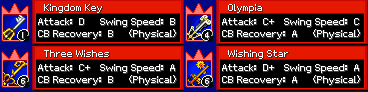
I don't actually know the difference between C and A Swing Speed but you can feel it.
After a few worlds/floors of the game I was finding my deck wasn't doing much good for me. The Kingdom Key card is not very fast or strong, and you're saddled with a lot of sub-6 value cards when enemies are regularly using 6s against you. Getting new attack cards is kind of up to luck too: you get them from hitting objects, chests, or sets of five from moogles, and all of these are randomised in terms of keyblade type and number value.
... so that's like, not great. So I gotta make best use of the resources I have. I'm playing on the 3DS via Virtual Console injection, I'm not about to be using save states here.
Having so many 1-4 cards resulted in frequently getting card breaks, and despite being on the higher end of strength, Olympia wasn't really doing it for me because it results in a slow attack rate. I decided I needed to focus on higher value cards and higher attack speed with the likes of Three Wishes (Agrabah) and Wishing Star (Monstro). I also lined up my cards to hopefully pull off some sleight combos, and so premium cards were in the most efficient position.
Which is how I discovered Sonic Blade.
... and I suddenly felt like I was actually playing the game the way it wanted me to play it.
One problem I had when I played the game originally (besides the fact it was my first Kingdom Hearts so I had no idea the context behind anything) is that I wasn't actually engaging with most of its gameplay — I didn't spend enough time actually fighting everything. Here I made sure to clear out a room of spawning Heartless basically 100% of the time. You might be thinking... well if you're not fighting enough battles of course you won't be strong enough... but I was a young teen, not that into JRPGs yet, and this was my first Kingdom Hearts game.
Everyone ran away from 80% of the wild encounters in Pokemon, and same thing was happening here.
So Sonic Blade is obviously really good, clearing out 50-100% of Heartless on-screen. My point here though is that the game wants you to be using sleights a lot. They're powerful combos that hit multiple targets and can result in a value over 9, avoiding your attack getting broken and cancelled. (0 cards aside.) While you lose one card in a sleight for the rest of the battle, you won't need to worry about this for random encounters, and this is what premium cards are best used for since they're can't be reloaded anyway.
I didn't care for sleights originally! I couldn't understand why I should use them, and didn't want to remember the conditions for activating them. It felt like extra complications on top of having to think about numbers at all. I just wanted singularly strong cards and to hit enemies by mashing Ⓐ a bunch. Perhaps because of not having played the first game beforehand originally, I didn't have the context for wanting to use these cool moves. They're not perfect solutions, they don't solve every encounter, but the Sonic Blade moment made me realise that sleights are meant to be your main toolkit.
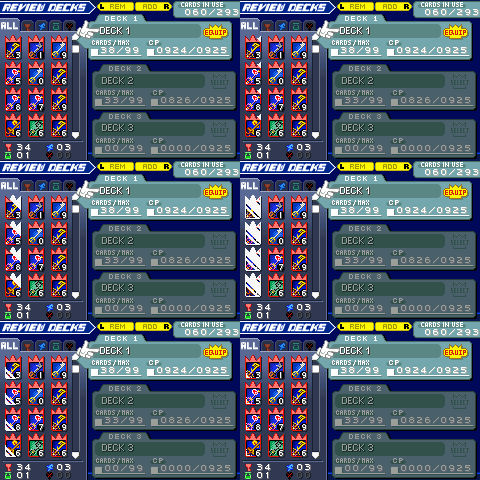
I will admit I basically don't touch summon cards outside Cloud, though. This doesn't really change much as summons have never been that good in Kingdom Hearts even to this day. There's maybe one summon per game that has beneficial utility like Regen, and the rest are simply more cumbersome and slow ways to beat enemies when you have a perfectly good club-sword-key. Magic is passable but expensive and inaccurate, especially when Donald uses it. It's best used against Heartless with front-side blocking like the Large Body and Defender.
Fighting battles in Chain of Memories is also important because that's how you get world cards, which are used to generate rooms for a given floor/world. In fighting everything I came across I actually ended up with too many world cards, capping out at 99 easily by mid-late game and having to go out of my way to spend cards regenerating rooms or just discard excess. But I had options! I know it sounds a little strange to say "I had more fun with the game when I actually played the game" and yet it feels like something I easily neglected before, simply because I was running against the friction of playing the game with a bad hand and strategy.
Without much better place to talk about it, let's talk about how the original Chain of Memories is better than Re: in the first place — it's the ability to see and understand what's going on in battle.
I've never been completely fond of the argument that design informed by limitations of the era are done intentionally and thus remakes free of those limits are missing that intentionality. The design around such limits is accidental at best, however this isn't to discount the emergent design either. Something can have meaning without being intentional. The way Chain of Memories combat feels to play is a part of this.
It's not immediately obvious, but the constrained battle screen of the GBA version of the game is actually extremely beneficial to the player. You can see practically every enemy on-screen nearly all times, and it being 2D puts a limit on movement space to worry about. In contrast, the 3D nature of the remake introduces much larger arenas, the camera easily hides targets out of sight, and the enemies have way more HP. This creates more information the player has to juggle on top of the card numbers! It makes the battles more frustrating to play than they should be, whereas the GBA combat feels tighter.
But maybe we should talk about the story a little too.
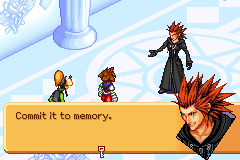
Sorry, you get the original translation here.
The story is honestly probably a bad starting point for someone to get into the series, which is unfortunate as it was very likely the starting point for a lot of kids that had Gameboys but no Playstations. (Or could emulate the GBA.) It's a direct sequel to the first game, following off the events of the ending, and frequently makes reference to those events with expectation of you knowing what should be "normal true reality" for the characters involved. If you're not paying attention to intuit that context, you're going to get lost once that true reality starts slipping through Sora's fingers.
However this game is also the first point in the series that it really starts being what we now understand as Kingdom Hearts, and I'm not talking simply because of the Organisation and their black cloaks. This is the game with a real meaty mystery element.
The Organisation XIII members are fascinating characters because you are given several little scenes where they are talking about things you don't quite have all the information to understand. The GBA version has some differences in the script — some good and some bad — but the vibe between releases is overall the same. You slowly get the picture you're caught up in a coup where Sora is a convenient pawn that happened to wander in, and then eventually perhaps not so convenient, but guided to be.
At the same time the machinations of the Organisation aren't important to Sora, he doesn't even know there's an internal power struggle happening at all, and it's barely relevant to him even at the end. He's much more concerned about remembering somebody he used to know (or didn't), and trying to understand why his boyfriend childhood friend is antagonistic and emo. There's something fun about these two parallel conflicts happening — or more if we include Reverse/Rebirth — because it avoids the story orbiting entirely around Sora.
The game doesn't introduce Organisation XIII formally by name yet, and thus at the same time doesn't have you worry about thirteen characters. Sora's side is only concerned with Axel, Larxene, Vexen, and Marluxia. Xemnas is only ever talked about as a mysterious Superior. This gives these characters what moments they have more time to shine, though some characters definitely see a little editorial revision later.
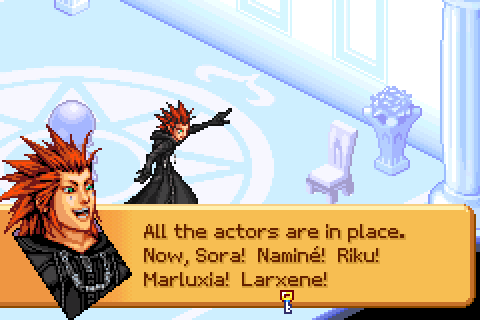
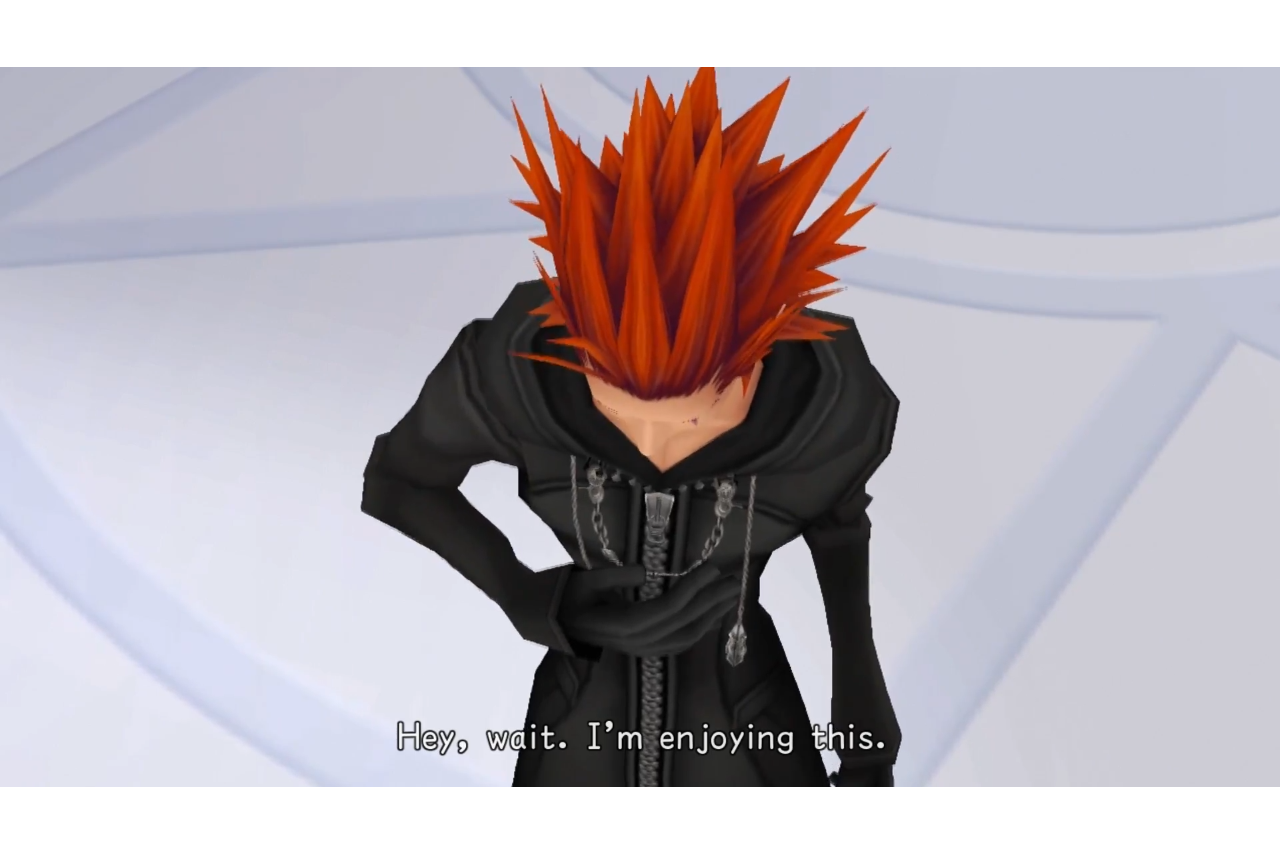
This scene is an especially notable update for Axel's personality.
If Chain of Memories has any story weakness its in its Disney world sections. They drive the overall themes of the main plot well enough, but since every world is nothing more than a memory-based illusion within Castle Oblivion, they don't contribute back to the arcs of the Disney characters' real selves which will have continuity in other games. The characters also occasionally forget they're even interacting with memory illusions, or perhaps simply rolling with what's going on because to constantly remind the player would get annoying.
Some of them do have interesting implications though, like Halloween Town and its talk about "true memories". This mostly comes into play when Sora will learn his memories have been tampered with, and what that means for emotional investment in those fake memories. At the same time because everyone in these memory worlds are nothing more than illusions from Sora's mind, what does it mean for one of them to become self-aware? Especially in a setting that will later question the personhood of everything. What defines what you are? Are you your body? Your collected thoughts? The collection of your memories? Are you the culmination of your life events? Even Riku Replica gets this treatment what with his whole mind being based on constructed memories.
Even with the first Kingdom Hearts having its own light mystery around Riku and Kairi, its ultimately a pretty simple good-vs-evil conflict. Your childhood friend boyfriend has been tempted by darkness out of a need to see more to life and roped into kidnapping your friend because of something to do with pure hearts of light. It's quaint. Chain of Memories meanwhile has bad guys with differing motivations, back-stabbing, and whether you can care about someone even with fake memories and having been brainwashed by them for several hours.
Sora's just that much of a softie, admittedly.
he said the thing
When I say Chain of Memories is a "good" game, I'm not suggesting it's amazing. It takes some getting used to, and sometimes is just an arsehole to you. I had to set up a second deck made entirely of 8/9/0 cards and activating a passive that hid your numbers to get past certain bosses. If I encountered those bosses 20-ish years ago who knows if I would've cared to beat them legit. Knowing how to use the tools the game lays out before you goes so much better.
The characters and atmosphere is great. It's interesting to see pieces of the new cast slowly unfold before you while Sora is mostly going about his own thing — with the knowledge something will eventually catch up to him. Castle Oblivion Floor 13 is a good final dungeon vibe. It feels oppressive in a hollow sense, the characters unsure how much more they're going to lose of themselves.
There are definitely still better games in the series, I'm certainly not going to deny that. In terms of the plot, Re:CoM is still just as applicable (if not moreso) as a way to keep up with the story. Overall though, the original Chain of Memories is "good" in its own space and time, and I've enjoyed my time with it more than when trying to tackle its remake.